
Videos · Guides · 29 Jun 2026 · 48 min
Thailand first visit: fewer stops, the free arrival card, app rides
Fewer places, the free arrival card, two bank cards and rides by app: timing, money, transport, food and the rules a first visit needs.
Video: Thailand For Beginners: The Complete Guide To Your First Visit (2026)
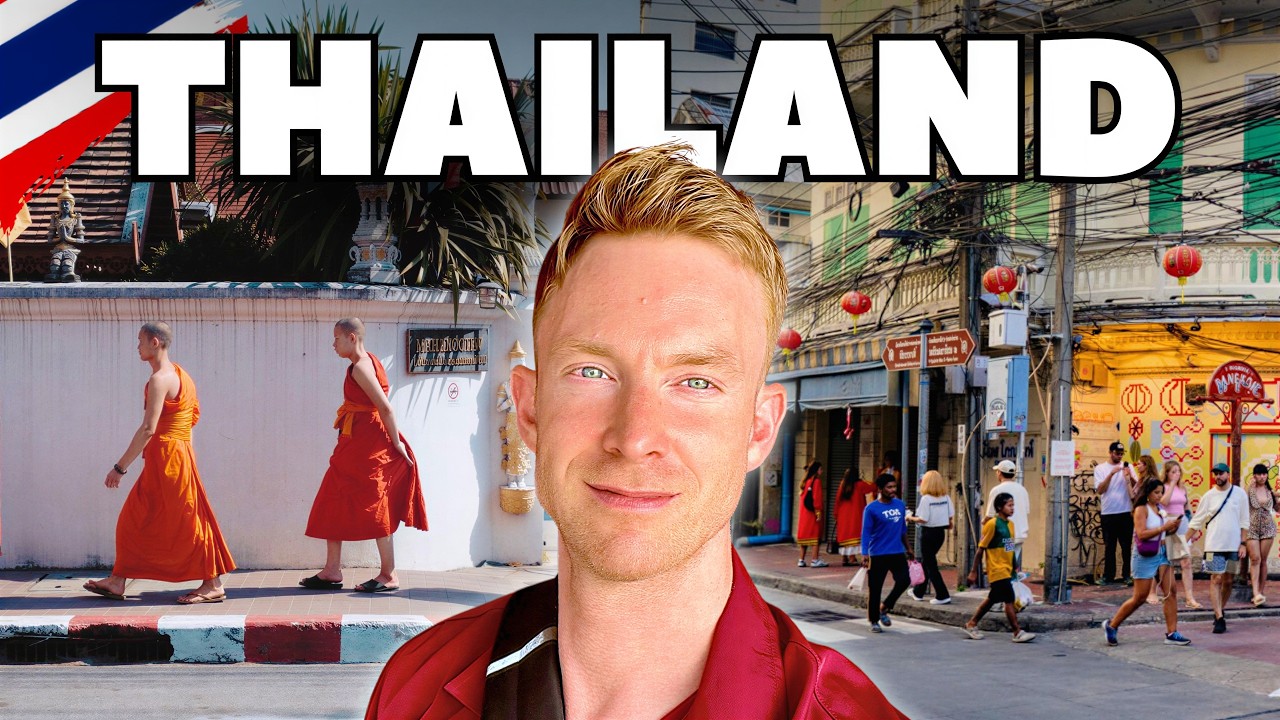
Filmed 29 Jun 2026. Rules and prices in Thailand change often: check entry rules right now and the daily news before you rely on anything here.
The short version
- Pick fewer places and stay longer: one week is Bangkok plus one other stop, and three or more regions need at least two weeks.
- File the free arrival card (TDAC) within the three days before you land, on the official site only, and check the entry rules board the week you fly.
- Thai ATMs charge foreign cards roughly 250 baht a withdrawal, depending on the bank, so take out larger sums less often and always choose baht, not your home currency.
- Book rides in Grab or Bolt, insist on the meter in street taxis, and fix a tuk-tuk fare for the whole ride before you get in.
- Do not rent a scooter to learn on. Without a motorcycle class on your licence or permit, you ride unlicensed and your insurance can refuse the claim.
- Vapes are banned, cannabis flower needs a Thai prescription, and online posts can be prosecuted as defamation.
Fewer stops make a better first visit: one week is Bangkok plus one other place. File the free arrival card before you fly, and book rides in an app.
Who it’s for: anyone planning a first trip of one to three weeks. Who can skip it: residents and repeat visitors, who will find more use in the guides on visas and getting around Bangkok.
Before you go
Pick the season
The Thai Meteorological Department splits the year into three seasons.
| Months (approx.) | Season | What to expect | The catch |
|---|---|---|---|
| Mid-October to mid-February | Cool, dry | Clearest skies and the most comfortable weather | Peak prices and crowds, and rooms sell out around Christmas and New Year |
| Mid-February to mid-May | Hot | April is the hottest month | Heat exhaustion for anyone who packs a full sightseeing day in the afternoon |
| Mid-May to mid-October | Rainy | Short, heavy downpours, greener scenery, lower prices | August and September are the wettest months, and flooding is possible |
One regional exception matters. From about February to April, crop burning blankets the north, Chiang Mai especially, and Bangkok sees haze too. Smoke peaks around March.
If you can choose freely, November to January is the easiest window overall, with the price premium to match. Check live conditions before you book anything non-refundable.
Pick the region
Most first-timers start in Bangkok because the flights, trains and buses all fan out from it. That is a sound choice, with one correction: Bangkok is a base, not the whole of central Thailand.
| Region | Best for | The catch |
|---|---|---|
| Bangkok and central | Temples, markets, food, malls; day trips to Ayutthaya’s brick ruins, or Koh Samet and Koh Chang for a short island stop | Heat and traffic; the city is large and tiring in the afternoon |
| North (Chiang Mai, Pai, Chiang Rai) | Cooler hills, old-town temples, cooking classes, ethical elephant sanctuaries | Smoke from roughly February to April; the road to Pai is long and winding, so bring motion-sickness tablets |
| Andaman coast (Phuket, Krabi, Koh Lanta) | Limestone cliffs, clear water, island boat trips | Rough seas in the rainy season, and boat trips can be cancelled |
| Gulf coast (Samui, Phangan, Tao) | Calmer islands; Koh Tao is the diving centre | Rain patterns differ from the Andaman coast; check the forecast |
Maya Bay on Phi Phi Leh runs under national park rules: a visitor cap and an annual closure in the monsoon, usually August and September. Book a full-day trip, leave early, and confirm the bay is open when you book.
Beyond these four regions, Kanchanaburi (war history, waterfalls), Khao Sok National Park and the northeastern Isan region reward anyone who wants fewer tour groups.
Pick the length
The common mistake is a ten-day itinerary with five stops. You spend half of it in airports, boats and vans.
| Time | Plan | The catch |
|---|---|---|
| One week | Bangkok plus one other place, such as four nights in the capital and two on Koh Samet | Every extra stop costs most of a day in transit |
| Two weeks | Bangkok, one northern base and one beach, with short trips from each | Still a rush if you add a fourth region |
| Three weeks or more | Time to stay put, rent by the week and see places the tour buses skip | Costs and visa rules matter more the longer you stay |
Plan around the festivals
Songkran, the Thai New Year, is an official three-day holiday on 13 to 15 April. It is a nationwide water fight, and in some places the celebrations stretch on for days. Expect the year’s biggest crowds and highest hotel prices. Use Grab or Bolt rather than riding yourself, and put your phone in a waterproof pouch.
Loy Krathong falls on the full moon of the twelfth lunar month, usually in November, so the date moves each year. People float small rafts of banana leaf, flowers and a candle on rivers and ponds. Chiang Mai marks it alongside Yi Peng, the lantern festival. Book rooms there months ahead.
Sort the entry paperwork
The rules here change faster than anything else in this guide, so keep the detail on the entry rules board and check it the week you fly.
What does not change much:
- Arrival card. Every foreign arrival completes the Thailand Digital Arrival Card online within the three days before landing. It is free. Use only the official site, tdac.immigration.go.th; look-alike sites charge fees. Save the QR code on your phone. The step-by-step guide covers each field.
- Passport. It needs at least six months’ validity and should be undamaged.
- Proof you are leaving. Carry an onward or return ticket, your first night’s address and, if asked, proof of funds. The board lists the current figures.
- Overstaying. The fine is 500 baht for each extra day, capped at 20,000 baht, and a long overstay (over 90 days) can mean deportation and a ban on returning. Check the date on your entry stamp or receipt.
Since filming: the visa-free stay for most Western passports is now 30 days, not 60, and for tourism only. The entry rules board carries each rule with the date it last changed. For longer stays, see which visa fits.
Insure yourself
Thailand’s private hospitals are good, and priced to match. A fracture on a boat trip or a scooter crash can cost more than the rest of the holiday.
Buy cover before you leave and check four things:
- It includes medical evacuation.
- It covers hospital stays and ambulance, not only doctor visits.
- It covers scooter riding if you plan to ride, and states what licence you need.
- The exclusions for pre-existing conditions are ones you can live with.
The healthcare guide goes through what policies cover and leave out.
Pack light
Thailand sells almost everything you will forget, from toiletries at 7-Eleven to cheap clothes in every market, and low-cost domestic airlines charge for extra bags.
- Plugs and voltage. The supply is 230 volts at 50 Hz. Most sockets take both flat two-pin and round two-pin plugs, so North American and most European devices fit; UK and Australian plugs need an adapter. Check your charger says 100-240V.
- Power banks. Keep power banks in cabin baggage, never checked. Airlines increasingly ban using or charging them in flight and limit how many you carry; check your airline’s rule.
- One temple outfit. Shoulders and knees covered. Many temples refuse entry otherwise.
- Light, breathable clothes. Even in the northern hills, a market stall sells a warm layer for a few hundred baht.
- Medication. Carry it in original packaging with a doctor’s letter, and no more than 30 days’ supply. Opioid painkillers and other controlled drugs need a Thai FDA permit before you travel.
Land and get connected
Your first problem is a working phone. You have three options.
| Option | Good for | The catch |
|---|---|---|
| eSIM | Trips of one to three weeks and multi-country trips; install before you fly and switch on when you land | Dearer per gigabyte than a local plan |
| Tourist SIM from the airport counters | Anyone who wants a physical SIM straight away | Slightly dearer than a shop SIM; you register with your passport |
| Local prepaid SIM from a carrier shop | Stays of a month or more | You are offline until you reach a shop; registration with your passport is required |
A good plan for a longer trip is an eSIM for day one and a prepaid SIM from a carrier shop once you are settled.
One trap: if you swap your home SIM for a Thai one, texts to your home number stop arriving. Move two-factor codes to an authenticator app before you leave, or you can lock yourself out of your bank.
Install before you land:
- Grab and Bolt for cars, bikes and food.
- LINE, the messaging app Thai businesses use.
- Google Maps and Google Translate, with the Thai language pack downloaded.
- 12Go for booking trains, buses and ferries.
- ViaBus for Bangkok’s city buses.
- An air-quality app, if you are heading north between February and April.
For the airport itself, the first-hour guide takes Suvarnabhumi in the order you meet it.
Where to sleep
Stay near a station in Bangkok. A short walk to a BTS or MRT stop does more for your trip than a pool. Where to stay in Bangkok compares the areas.
The Khao San backpacker area is the usual exception to catch people out. It has no BTS or MRT station. Reach it by river boat to Phra Arthit pier (N13) on the orange-flag or blue-flag boats, or by taxi from the nearest MRT stop. Plenty of visitors enjoy it, but you will depend on boats and cars.
Before you book:
- Read recent reviews on more than one site. Look for repeats: noise, building works, a different room from the one pictured.
- Be careful with short-term condo rentals. Renting a residential unit for under 30 days is generally not allowed under Thai hotel law, and many buildings ban it themselves. Guests have reported arriving to a different, worse unit than the one they booked. For a short trip a hotel is simpler.
- For a month or more, look at serviced apartments that rent by the week or month. You usually pay for electricity and water on top, often at above-utility rates.
- Book early for peak dates. Songkran, Loy Krathong, Christmas and New Year sell out and prices jump.
Money
Thailand’s currency is the baht. Hotels, malls and chain restaurants take cards. Markets, street food and small shops want cash.
ATMs
Thai ATMs charge foreign cards a fee on every withdrawal, roughly 250 baht, depending on the bank. Your home bank may add its own on top.
- Withdraw larger amounts less often. Many machines cap a withdrawal at 20,000 to 30,000 baht.
- Read the fee on screen before you confirm.
- Decline the home-currency offer. If the machine offers to charge you in dollars, pounds or euros, choose baht. The rate it uses is worse than your bank’s.
- Bring two cards and keep one in your room safe.
- Wait for your card. Thai machines give you the cash first and the card second, and people walk away without it.
A travel debit card that refunds ATM fees is the cleanest fix. The money guide has more.
Changing cash
Skip your home airport and the bank counters. The dedicated exchange booths, such as SuperRich, have better rates. Take your passport, and bring clean, undamaged notes: worn ones get refused.
What things cost
Budgets swing widely, so use anchors rather than a daily figure. A single BTS trip costs from 17 baht, rising with distance. Bangkok has the widest range of prices and is the cheapest place to stay in comfort; the islands cost more and the north costs less.
Alcohol is the budget leak. A beer from a convenience store can cost as much as a street meal. The cost-of-living page lists current prices item by item.
Getting around
Between cities
| Mode | Good for | The catch |
|---|---|---|
| Domestic flight | Bangkok to Chiang Mai, Phuket, Krabi | Budget airlines charge heavily for extra baggage |
| Train | Slow, scenic travel; the Bangkok to Chiang Mai sleeper takes roughly 12 to 13 hours | Popular sleepers sell out days or weeks ahead |
| VIP and standard bus | Cheap overnight and mid-distance routes | Keep valuables with you, not in the hold |
| Minivan | Short hops where there is no train | Cramped on anything over a couple of hours |
| Private car | Groups, who split the cost | Dearest for solo travellers |
On sleeper trains, book a lower berth if you can: it is wider than the upper one and has a window.
Within cities
In Bangkok, the BTS Skytrain and MRT cover most of what visitors want, in air conditioning, above the traffic. The transport board lists fares and hours.
| Option | Good for | The catch |
|---|---|---|
| BTS and MRT | Most sights, airport links and malls, above the traffic | Stations can be a walk from the temples and the old city |
| River boats | Cheap, quick trips to the temples and the old city | Fixed piers and daytime hours |
| City buses | Cheap routes everywhere | Confusing for newcomers; use ViaBus |
| Grab or Bolt | Your default across Thailand: you see the price before you confirm and can follow the route on the map | Slow in rush hour |
| Street taxis | Short hops when no app car is near | Insist on the meter; if the driver refuses, get out and take the next one |
| Tuk-tuks | One ride for the experience, as a novelty rather than transport | Agree the fare first, and confirm it covers the whole ride, not each passenger |
| MuvMi electric tuk-tuks | Set districts in Bangkok at fixed prices | Limited areas |
| Songthaews | Pattaya’s baht buses run fixed routes (ride, press the bell, pay on exit). Chiang Mai’s red songthaews are shared taxis, so agree the fare first | Learn the main routes first |
Motorbikes
Do not use Thailand to learn to ride. City traffic is dense, motorbike crashes are a leading cause of serious injury to visitors here, and even experienced riders find it hard.
If you ride, sort three things:
- The right licence. You need a motorcycle class on your home licence, and an International Driving Permit that carries it. An IDP only translates what you already hold, so a car-only licence gives a car-only permit. Rental shops often hand over keys without asking. The driving licence guide has the detail.
- Insurance. Without the right licence, insurers can refuse any claim, leaving the hospital bill and the bike’s repair to you. Wear a helmet.
- A careful shop. Rent from an established shop with plenty of recent reviews. Film every scratch before you leave, and never hand over your passport as a deposit; offer a photocopy or cash instead.
Police checkpoints in tourist areas do check licences, and the fine is paid on the spot.
Eat well, and carefully
A street-food plate costs 50 to 60 baht, and it is the best meal you will have. Try far more than the handful of dishes your local Thai restaurant serves.
- Eat Thai style. Order several dishes to share. Plates arrive in no set order, so solo orders leave someone waiting.
- Night markets let you sample many dishes in one sitting.
- Watch the heat. Say mâi phèt (ไม่เผ็ด) for not spicy.
- Follow the locals. A stall feeding the same neighbourhood every day depends on repeat custom. Tourist-only places can be hit or miss.
- Choose cooked to order over dishes that have sat in trays in the heat. Raw salads, cut fruit and smoothies carry the most risk, since they are never cooked.
- Drink bottled or filtered water. Tap water is fine for showering and brushing your teeth, but do not drink it. Ice from restaurants is generally made from purified water; be warier at small roadside stalls.
Eat gently on a day you travel.
Stay healthy
- Dengue is the mosquito-borne illness worth taking seriously. Thailand’s health ministry advises repellent and covering up, especially around sunrise and sunset, and the risk rises in the rainy season. Avoid aspirin and ibuprofen if you get a fever, and see a doctor.
- Heat. Drink water steadily instead of waiting until you are thirsty, and schedule outdoor sights for the morning. Heat stroke can arrive before you notice it, and it is more dangerous for older people and small children.
- Crossing the road. Drivers do not reliably stop at zebra crossings, and some motorbikes ride against traffic. Look both ways, even on a green man.
- Clinics and pharmacies. Clinics are everywhere, and tourist areas have English-speaking staff. Many medicines that need a prescription at home are sold over the counter. The healthcare guide covers hospitals.
- Emergencies. Call 1669 for an ambulance, 1155 for the tourist police (English-speaking) and 191 for the police. The emergency page prints on one sheet.
Laws that catch visitors out
- Vapes and e-cigarettes are banned. Importing them is an offence the government lists as carrying up to 10 years in prison, and visitors have been fined on the spot at checkpoints. Leave them at home.
- Smoking is banned in many public places, including designated beaches and parks. Littering, including cigarette butts, brings fines.
- Cannabis flower has needed a Thai prescription since June 2025. Tourists may not buy, carry or use it without one, and public smoking is banned. Never carry it across a border: neighbouring countries punish it severely.
- Other drugs carry heavy penalties. Never accept anything from a stranger.
- Alcohol is sold in shops and bars, but not in parks or on public transport. Sales can be restricted on major Buddhist holy days; check the calendar.
- Defamation is a crime. A negative post, review or clip about a person or business can bring a criminal complaint, with a maximum of two years in prison and a 200,000-baht fine for published statements. Stick to facts, and keep arguments off social media.
Manners that matter
Mistakes often go uncorrected, so watch what locals do and copy it.
- Temples. Cover shoulders and knees, remove your shoes before entering a building, keep your voice low, and do not pose irreverently with sacred images.
- Monks. Do not touch a monk. Women should not hand anything directly to one.
- Head and feet. The head is the highest part of the body and the feet the lowest. Do not touch someone’s head, point with your feet, or put your feet on furniture.
- Spirit houses. The small shrines outside buildings, often with offerings such as bottles of red fizzy drink, are sacred. Do not sit or eat at one.
- Dress. The country is more conservative than the beaches suggest. Do not walk around a city without a shirt.
- Stay calm. Raising your voice makes you the problem, whatever the facts. If something cannot be fixed, let it go. Mâi pen rai (“never mind”) is the attitude that helps. For something serious, call the tourist police on 1155.
Scams
Most interactions are friendly and honest. Scams cluster in the busiest tourist areas and are easy to dodge once you see the pattern.
- The friendly stranger. Someone approaches you near a major sight, with news that a place is closed or a tip about a special deal. It usually ends at a shop, an overpriced tour or a pickpocket. Keep walking.
- Taxi and tuk-tuk hustles. Organised taxi and tuk-tuk operators work the busiest tourist spots. Use a booking app, or agree the fare first and decline any recommendations.
- Wrong change. Count it at the till, and carry small notes so you never hand over a 1,000.
The scams guide covers the rest.
Chapters
- 0:00Why plan in this order
- 0:41When to visit
- 3:01Where to visit
- 8:05Best festivals
- 10:07How long to stay
- 12:23Budgeting
- 16:39Health insurance
- 18:02Getting money
- 20:32Packing
- 22:58SIM cards and apps
- 25:53Where to stay
- 28:38Getting around Thailand
- 30:27Motorbikes
- 32:29Getting around cities
- 34:50Food
- 38:02Staying healthy
- 40:24Laws to know
- 42:04Cultural mistakes
- 44:56Scams
- 47:14Entry rules
Watch next
 35 minCondo & house tours · $2,500/month · Written guideA 145 m² Soi 8 corner condo for 85,000 baht, down from 110,00028 Oct 2026
 28 minGuides · Written guideYour first hour in Bangkok: Suvarnabhumi arrival, step by step23 Oct 2026
 33 minCondo & house tours · $750/month · Written guideA $750 condo in Phrom Phong, and the two-year lease that got it19 Oct 2026
Thailand, every Thursday.
One email a week. Free, and you can leave in one click.
- What's on in Bangkok this weekend
- Entry and visa changes, in plain English
- One guide worth reading, kept up to date