
Guides · Get Around · Bangkok
Getting around Bangkok: trains, boats, taxis and apps
Rail for crossing town, the river for the old city, Bolt or Grab after midnight. Current fares, hours and cards for each, plus both airport transfers.
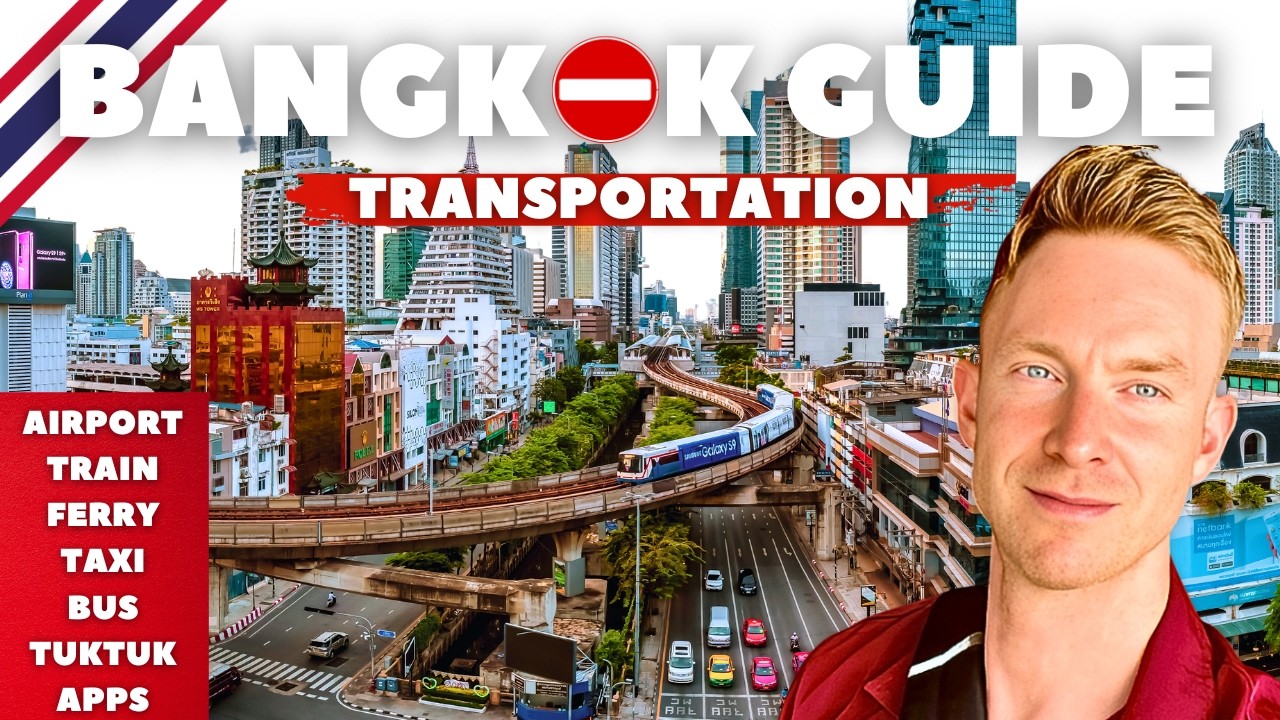
Earlier versions: Getting Around in Bangkok: 16 Worst Transportation Mistakes to Avoid, First Hour at Don Mueang: 15 Worst Arrival Mistakes to Avoid
Key things to know
- BTS Skytrain: 17 to 47 baht in the central section, up to 65 baht onto the extensions. It still doesn't take bank cards, so buy a ticket, a Rabbit card or a 150-baht One-Day Pass.
- MRT Blue line: 17 to 44 baht since 3 July 2026. Tap a contactless Visa or Mastercard credit card at the gate.
- Airport Rail Link: 45 baht from Suvarnabhumi to Phaya Thai, about 30 minutes, 5:30am to midnight.
- Each system charges its own fare. Changing from BTS to MRT means paying a second entry fare.
- On the Red and Purple lines, a contactless card caps your fares at 40 baht a day until 30 November 2026, unless the cap is extended.
- River express boats rose by 1 baht on 5 October 2026: orange flag 19 baht, yellow 24. The blue-flag tourist boat is 40 baht a trip.
- Taxi meters start at 35 baht. From the airports, add a 50-baht surcharge and the tolls.
- The free bus between Suvarnabhumi and Don Mueang is only for passengers with a connecting boarding pass.
Take the train. For any trip across Bangkok in daylight, the BTS Skytrain, the MRT and the Airport Rail Link beat a car on time and price, often by an hour at rush hour. Use the Chao Phraya river boats for the Grand Palace, Wat Arun and Chinatown, and use Bolt or Grab for anything the rails don’t reach or after the trains stop at midnight.
Today’s hours, fares and closures: see Bangkok transport, the line-by-line status board.
Since filming: MRT stored-value cards stopped working on 1 June 2026, and MRT, river-boat and canal fares have all risen. The fares on this page were checked on 25 October 2026.
Who this is for: first-time visitors, and new residents who haven’t yet worked out which card goes with which line.
Who should skip it: anyone with a hotel transfer booked and a tour bus every day. You won’t need most of this.
The rail network at a glance
| System | Lines | Fare | Hours | How to pay |
|---|---|---|---|---|
| BTS Skytrain | Sukhumvit and Silom (green) | 17–47 baht centrally; up to 65 with the extensions | About 5:15am to midnight | Coins or notes at machines, Rabbit card, One-Day Pass. No bank cards |
| BTS Gold Line | Krung Thon Buri to Khlong San, via ICONSIAM | 16 baht flat | 6am to midnight | Separate ticket |
| MRT Blue | Loop through Sukhumvit, Silom, Chinatown, Chatuchak | 17–44 baht | About 6am to midnight | Contactless Visa or Mastercard; tokens |
| MRT Purple | Tao Poon to Khlong Bang Phai (Nonthaburi) | 14–42 baht | About 5:30am to midnight | Contactless card (capped at 40 baht a day); tokens |
| Yellow and Pink monorails | Lat Phrao–Samrong; Khae Rai–Min Buri | 15–45 baht | About 6am to midnight | Contactless card, Rabbit card, tickets |
| Airport Rail Link | Suvarnabhumi to Phaya Thai | 15–45 baht | 5:30am to midnight | Contactless card; tokens |
| SRT Red lines | Krung Thep Aphiwat to Rangsit (via Don Mueang); Taling Chan | 12–42 baht | About 5:30am to midnight | Contactless card (capped at 40 baht a day, shared with the Purple line); tickets |
Fares were checked on 25 October 2026. They depend on the number of stations you travel, so Google Maps or each operator’s app gives the exact price for your trip.
The catch with all of it: every system is run separately. Change from the BTS to the MRT at Asok, Sala Daeng or Mo Chit and you leave one gate, walk to the other system and pay again. A single 17–45-baht fare across all lines is planned as a one-year trial from 1 January 2027, but only for Thai nationals who register a bank card through the Paotang app. Visitors and foreign residents will still pay each system’s own fare.
The 40-baht cap: on the Red and Purple lines, tap the same contactless bank card all day and you pay no more than 40 baht. It ends on 30 November 2026 unless it’s extended; the Transport Ministry has asked to extend it to 31 December 2027. Operators haven’t said whether foreign-issued cards get the cap, and one Thai report says it is for Thai nationals only, so don’t count on it.
BTS Skytrain
The verdict: the most useful line for visitors, and the most old-fashioned to pay for.
The Sukhumvit line runs east–west through Siam, Asok, Phrom Phong and Thonglor and north to Mo Chit for Chatuchak Weekend Market. The Silom line runs through Sala Daeng and Chong Nonsi to Saphan Taksin, where the river boats leave. They meet at Siam, and you can change between them without paying again.
Buying a ticket. The ticket machines sell single-journey cards. Many older machines take only coins, so keep 10-baht coins, or use the ticket office. Keep the card: you need it to get out.
For more than a day: the One-Day Pass is 150 baht at ticket offices and covers unlimited trips on the Sukhumvit and Silom lines that day. It pays off after about four rides. For a longer stay, a Rabbit card is a stored-value card for the BTS and the Yellow and Pink lines. Buy it at a ticket office with your passport; you pay a one-off issue fee plus credit, and top up from 100 baht.
The catch: the BTS is the one major line that still doesn’t accept contactless bank cards. The operator is working with the government on card payments for the planned common fare, but there’s no date.
Rush hour runs about 7am to 9am and 5pm to 7pm. Trains come every few minutes and are packed; avoid them with luggage.
MRT Blue line
The verdict: the easiest system to use, because you just tap your card.
The Blue line loops from Lak Song in the west through Chinatown (Wat Mangkon), the Grand Palace (Sanam Chai), Sukhumvit, Lumphini and Chatuchak to Tha Phra. Since 1 June 2026, the old MRT stored-value cards no longer open the gates. Tap a contactless Visa or Mastercard credit card on the reader, and tap out with the same card. You can still buy single-journey tokens at the machines, which take notes.
The catch: some foreign debit cards are refused at the gate. Carry a credit card as a back-up, or buy a token. No eating or drinking on board, which applies on the BTS too.
Airport Rail Link, from Suvarnabhumi
The verdict: the cheapest and most predictable way into town if you can manage your bags on a train.
The station is in the basement of the terminal; follow the “City Line” signs from arrivals. Trains run from 5:30am to midnight, take about 30 minutes to the end of the line, and cost 15 to 45 baht. Suvarnabhumi to Phaya Thai, the last stop, is 45 baht.
| Change at | For | Notes |
|---|---|---|
| Makkasan | MRT Blue line at Phetchaburi | A covered walkway; best for Asok, Sukhumvit and Silom |
| Phaya Thai | BTS Sukhumvit line | Best for Siam, Victory Monument and Ari |
Pay at the gate with a contactless card, or buy a token from the machine or the booth. If you only have large notes from the exchange counter, use the booth.
The catch: security staff sweep each train before boarding, so allow a few minutes. In the morning and evening peaks, the trains fill with commuters, and the changes at Phaya Thai and Makkasan involve long walks.
From Don Mueang
Don Mueang, the low-cost carriers’ airport, has three good options.
- SRT Red line. Walk the covered bridge from Terminal 1 to Don Mueang station. The Dark Red line runs to Krung Thep Aphiwat, Bangkok’s central station, in about 15 minutes, where you change to the MRT Blue line at Bang Sue. Fares are 12 to 42 baht, and contactless card users are capped at 40 baht a day across the Red and Purple lines until 30 November 2026 (the ministry has asked to extend it).
- Airport buses. The A1 runs to BTS Mo Chit and MRT Chatuchak Park for 30 baht, every 15 to 20 minutes from about 5:45am to midnight. The A2 goes to Victory Monument for 30 baht. The A3 (Lumphini) and A4 (Sanam Luang, for Khao San) are 50 baht.
- Taxi or app. The public taxi queue is on the arrivals level. Bolt and Grab both pick up at the airport.
Between the two airports
The free shuttle bus between Suvarnabhumi and Don Mueang is only for passengers on a connecting flight. Show your onward boarding pass and your passport. It runs from 5am to midnight, every 30 to 60 minutes, and the trip takes one to two hours depending on traffic. At Suvarnabhumi it leaves from Floor 2, Gate 3; at Don Mueang, from Terminal 1, Floor 1, Gate 6.
Not connecting? Allow two hours and take a taxi, an app car, or the train: Airport Rail Link to Phaya Thai, BTS to Mo Chit, then the A1 bus or the Red line.
Chao Phraya river boats
The verdict: the best way to see the old city, and the best value ride in Bangkok.
Boats are colour-coded by the flag at the back. Fares rose by 1 baht on 5 October 2026, because of diesel prices.
| Boat | Fare | When it runs | Use it for |
|---|---|---|---|
| Orange flag | 19 baht | Weekdays, early morning and late afternoon only | Cheap commuter hops |
| Yellow flag | 24 baht | Weekdays; daytime and weekend services too | Fewer stops, faster |
| Green-yellow flag | 17–36 baht | Weekday peaks | Nonthaburi and Pak Kret |
| Red flag | 33 baht | Weekday morning peak | Air-conditioned express |
| Blue flag (tourist boat) | 40 baht a trip, or a 150-baht day pass | Daily, about 8:30am to 7:45pm | Sightseeing, with commentary |
| Cross-river ferries | A few baht | All day | Hopping to Wat Arun and Thonburi |
Board at Sathorn pier under BTS Saphan Taksin. Tha Chang and Tha Tien are the piers for the Grand Palace and Wat Pho; Ratchawong is for Chinatown.
The catch: the orange-flag boats run only at weekday peaks, so most visitors will use the blue-flag boat in the daytime. Check the timetable at the pier before an evening plan, and on ceremony or festival days, when services can be cut.
Canal boats on Khlong Saen Saep
The verdict: the fastest way from Sukhumvit to the old city in rush hour, if you don’t mind getting splashed.
The canal boats run parallel to Sukhumvit and Phetchaburi Road, from Wat Sri Boonruang in the east to Phan Fa Lilat near the Golden Mount, with a change at Pratunam. Fares were 16 to 26 baht after a rise in April 2026, paid to the conductor on board; check the board at the pier, as river fares have moved since. Boats run from about 5:30am to 8:30pm on weekdays, finishing earlier at weekends. Asok-Phetchaburi pier is by MRT Phetchaburi.
The catch: boarding is a step across a moving gap onto a wet deck. Skip it if you’re unsteady on your feet, and carry small notes.
Buses
The verdict: a cheap adventure, rarely the best way to get anywhere.
Red fan buses cost about 8 to 10 baht, and air-conditioned buses about 12 to 25 baht, paid to a conductor on board. Google Maps and the ViaBus app show routes and live arrivals.
The catch: routes are hard to read without Thai, and buses sit in the same traffic as everything else.
Taxis
The verdict: cheap when the meter runs, and worth the effort to make sure it does.
Bangkok meters start at 35 baht and add 6.50 baht a kilometre from the second to the tenth, rising a little after that. Sitting in traffic below 6km/h costs 3 baht a minute. A 5km trip in light traffic is usually 60 to 80 baht.
From Suvarnabhumi: the public taxi stand is on Floor 1, between gates 4 and 7. Take a queue ticket from the machine, keep it (it has the driver’s details), and walk to the numbered bay. You pay the meter, a 50-baht airport surcharge and any expressway tolls, which you hand to the driver at each booth. Large bags can carry a small extra charge. Expect about 300 to 500 baht to central Bangkok, including the surcharge and tolls.
Four rules:
- Insist on the meter. Say “meter, khrap” or “meter, kha”. If the driver refuses, get out.
- Wave down a moving taxi. The ones parked outside malls, hotels and tourist sights want flat fares.
- Follow the route on Google Maps, and carry small notes.
- Ignore recommendations. Shops, restaurants and tours suggested by a driver pay him commission.
Taxis of every colour charge the same rates.
Bolt, Grab and other apps
The verdict: the simplest option for newcomers. Book a car, see the price, and skip the haggling.
Bolt and Grab both work in Bangkok, with cars, taxis and motorbikes. You can pay by card in the app or in cash. Check both apps before you book. On short city trips, Bolt has often come in cheaper than Grab’s car options in our checks, and close to the taxi meter. If you take the expressway, you still pay the toll.
The catch: in busy areas, drivers occasionally ask for more than the app price, cancel and ask you to rebook, or turn up in a different car. Don’t get into a car that doesn’t match the plate in the app, and don’t pay above the app fare.
Tuk-tuks and motorbike taxis
Tuk-tuks don’t have meters. Agree the fare before you get in, and expect to pay two to five times a metered taxi. For the experience without the haggling, MuvMi runs electric tuk-tuks booked in its own app at fixed prices.
Motorbike taxis, in orange vests at stands by stations and sois, are the fastest way through traffic and the most dangerous; most of Thailand’s road deaths involve motorbikes. Agree the price first, or book one in Bolt or Grab. Don’t set your app pickup point at a motorbike-taxi stand: drivers at the stands have confronted app riders.
Quick reference
| Trip | Best option | Rough cost |
|---|---|---|
| Suvarnabhumi to Sukhumvit | Airport Rail Link + MRT at Makkasan | 45 + 17–44 baht |
| Suvarnabhumi with heavy bags | Public taxi from Floor 1 | About 300–500 baht with surcharge and tolls |
| Don Mueang to the city | Red line + MRT, or the A1 bus + BTS | 30–90 baht |
| Asok to the Grand Palace | MRT Blue to Sanam Chai | 17–44 baht |
| Siam to the river | BTS Silom line to Saphan Taksin, then boat | 17–47 + 24–40 baht |
| After midnight | Bolt, Grab or a metered taxi | Meter plus any tolls |
Thailand, every Thursday.
One email a week. Free, and you can leave in one click.
- What's on in Bangkok this weekend
- Entry and visa changes, in plain English
- One guide worth reading, kept up to date
Related guides
What's changed
| Date | Change |
|---|---|
| 25 Oct 2026 | First published |
Guidance, not legal, tax or immigration advice. Rules in Thailand can change with little notice; confirm with the official source before you travel.