
Guides · Stay Safe · Thailand
Scams in Thailand: how the common ones work, and what to do
Most scams here are small, polite and avoidable. The ones visitors meet, in the order they come, with the warning sign and the move that ends each.
Earlier versions: 34 Worst Scams in Thailand, Renting a Condo in Bangkok: 11 Simple Steps to Save Money and Avoid Scams
Key things to know
- Tourist Police: call 1155, 24 hours, in English. Or use the free Thailand Tourist Police app, which works without a Thai SIM.
- Lost money online or by bank transfer: call your bank first, then the 1441 online-fraud hotline, which can freeze the receiving account.
- The arrival card (TDAC) is free, and only at tdac.immigration.go.th. In March 2026, immigration said about one in ten arrivals had used a fake site.
- Never follow a tout, and never take advice on shops, gems, tours or restaurants from a taxi or tuk-tuk driver.
- Insist on the meter, or agree the price before any ride without one.
- Choose ATMs at bank branches, decline the conversion to your home currency, and never show your cash to a stranger.
- Don't send a deposit for a condo you haven't seen, or pay a fee to apply for a job.
- If you're caught out, stay calm and pay what's fair. Arguments rarely win money back and can escalate.
Thailand is a safe country to visit, and most of its scams take a few hundred baht from people who were in a hurry or too polite to say no. Three habits stop most of them: never follow a stranger who approaches you, never take a ride without a meter or an agreed price, and never send money to someone you’ve only met online. The rest is knowing what the setups look like.
Who this is for: first-time visitors, and anyone about to rent, buy or settle here.
Who should skip it: nobody, but if you only read one section, read Arriving and Getting around.
If it happens to you
| Situation | Call or use | What they do |
|---|---|---|
| Overcharged, cheated, threatened or robbed as a tourist | Tourist Police 1155, or the Thailand Tourist Police app | English-speaking help 24 hours; the app sends your location and has live chat |
| Money taken by bank transfer, card or online | Your bank first, then 1441 | 1441 is the government’s 24-hour online-fraud line; it can freeze the receiving account |
| Formal complaint about an online scam | thaipoliceonline.go.th | The Royal Thai Police reporting site; you’ll be given a case number and an investigator |
| Immediate danger | 191 | Police emergency |
| Lost passport or need an interpreter | Your embassy | Documents, and help dealing with the police |
Speed matters with money. A transfer to a Thai account can sometimes be frozen if it’s reported within hours. Get a case or reference number from every call.
Beware the second scam. Anyone who contacts you offering to recover your money for a fee is running another scam. The police and banks don’t charge to investigate, and the Department of Special Investigation has warned about fake “online crime report” websites run by the same gangs.
Arriving
Fake arrival-card websites
How it works: every foreign visitor must complete the free Thailand Digital Arrival Card online before landing. Look-alike sites, often high in search results, charge a fee and collect your passport details.
How to spot it: any site asking for payment, or any address other than tdac.immigration.go.th. Immigration said in March 2026 that about 10 per cent of arrivals had used fake sites.
What to do: type the address yourself, or follow the link from immigration.go.th. If you paid a fake site, contact your card issuer, then fill in the real card. The arrival guide walks through it step by step.
Theft from overhead lockers on the flight
How it works: organised thieves on regional flights wait until the cabin lights dim after the meal service, then search overhead bins and seat pockets for cash and jewellery.
What to do: keep cash, cards and valuables in the bag under your seat or on your body, especially on night flights from other Asian cities.
Airport taxi touts
How it works: on the departures kerb at Suvarnabhumi, a man asks where you’re going and quotes a flat fare. Cal was once quoted 1,000 baht for a ride to Rama 9; the metered taxi from the official stand one floor down cost 150 baht plus the 50-baht surcharge.
What to do: use the public taxi stand on Floor 1, the Airport Rail Link, or Bolt or Grab. The getting-around guide has the current fares.
Getting around
The no-meter taxi
How it works: taxis must legally use the meter, but drivers waiting outside hotels, malls and sights quote a flat price several times higher.
How to spot it: a parked taxi, a driver who names a price before you’ve sat down, or a “broken” meter.
What to do: wave down a moving taxi and say “meter, khrap” (men) or “meter, kha” (women). If the driver refuses, get out. In a busy area at a busy time, you can agree a fixed price, using the Bolt fare for the same trip as your guide.
The fast meter and the scenic route
How it works: a rigged meter runs at several times the normal rate, or the driver takes a long way round. A normal meter climbs by 2 baht at a time, slowly; a 10km trip in light traffic is usually under 100 baht.
What to do: follow the route on Google Maps from the start. If the meter races, pay what it showed when you noticed and take another taxi.
The wrong-change and swapped-note tricks
How it works: you hand over a 1,000-baht note and get change for 500, or a chatty driver asks to swap ten 100s for your 1,000 and then “finds” that you gave him a 100.
What to do: carry 20s and 100s for every ride, and refuse any request to swap notes. Any unusual request from a driver is usually the start of a scam.
Commission stops and the wrong pier
How it works: a driver recommends a seafood restaurant, a tailor, a gem shop or a tour. He earns a commission and you pay well over the going price. A variation takes visitors to floating markets to a private pier, where a boat costs around 2,000 baht.
What to do: say no to every recommendation and give the exact address of where you want to go. Book tours yourself.
Tuk-tuks and motorbike taxis
How it works: neither has a meter. Settle the price after the ride and it will be whatever the driver thinks you’ll pay.
What to do: agree the price before you get in, or book a motorbike through Bolt or Grab. Ignore the bargain “city tour”; it’s a ride to commission shops.
Ride-hailing app scams
How it works: the app driver asks you to pay more than the app price, cancels and asks you to pay cash off the app, or swaps you into a different car partway through the trip. On Grab’s taxi option, some drivers start the meter on the way to pick you up.
What to do: only ride in the car whose plate matches the app, pay the app price, and refuse to switch cars. The meter on a Grab Taxi should start when you get in. Report problems in the app.
The songthaew “charter”
How it works: in Pattaya and other smaller cities, songthaew pick-ups run fixed routes for as little as 10 baht a person. Ask the driver at his window whether he goes somewhere, and some will treat it as a private hire and charge 200 to 500 baht.
What to do: hop in the back without negotiating, ring the bell near your stop and pay the standard fare at the driver’s window.
Bus and train station touts
How it works: at stations, someone tells you the bus or train is full and offers a private van instead, sometimes claiming to work for the Tourism Authority of Thailand.
What to do: walk to the ticket counter. TAT is a government agency and doesn’t sell transport.
Rental damage, fake theft and fake accidents
How it works: a motorbike or jet-ski shop blames you for old damage. In newer versions, staff follow you and take the bike with a spare key, then charge you for it; or you get a call about an “accident” you never had and are told to pay a complainant at a police station.
What to do: rent from large, long-established shops with many Google reviews, or through your hotel. Photograph and film the vehicle, including scratches, before you leave. Never leave your passport as a deposit. Call 1155 before paying anyone over a claimed accident.
On the street
The friendly stranger
How it works: someone strikes up a conversation, asks where you’re from and shows a surprising knowledge of your country. Then comes the ask: a fortune told for a fee, a request to see your home currency (and a sleight-of-hand swap), a “miracle cure” shop for your hair loss, or an invitation to coffee, then to a restaurant or a flat. One common version: a man and his “daughter” ask for advice about studying in your country, and grow angry when you leave. Invitations like that can end in a huge restaurant bill and, rarely, in drugging and robbery.
How to spot it: any stranger in a tourist area who opens with “Where are you from?” and won’t let you walk away.
What to do: smile, say no thank you, and keep walking. Never show your wallet. If you agree to meet someone, choose the restaurant yourself.
“It’s closed today”
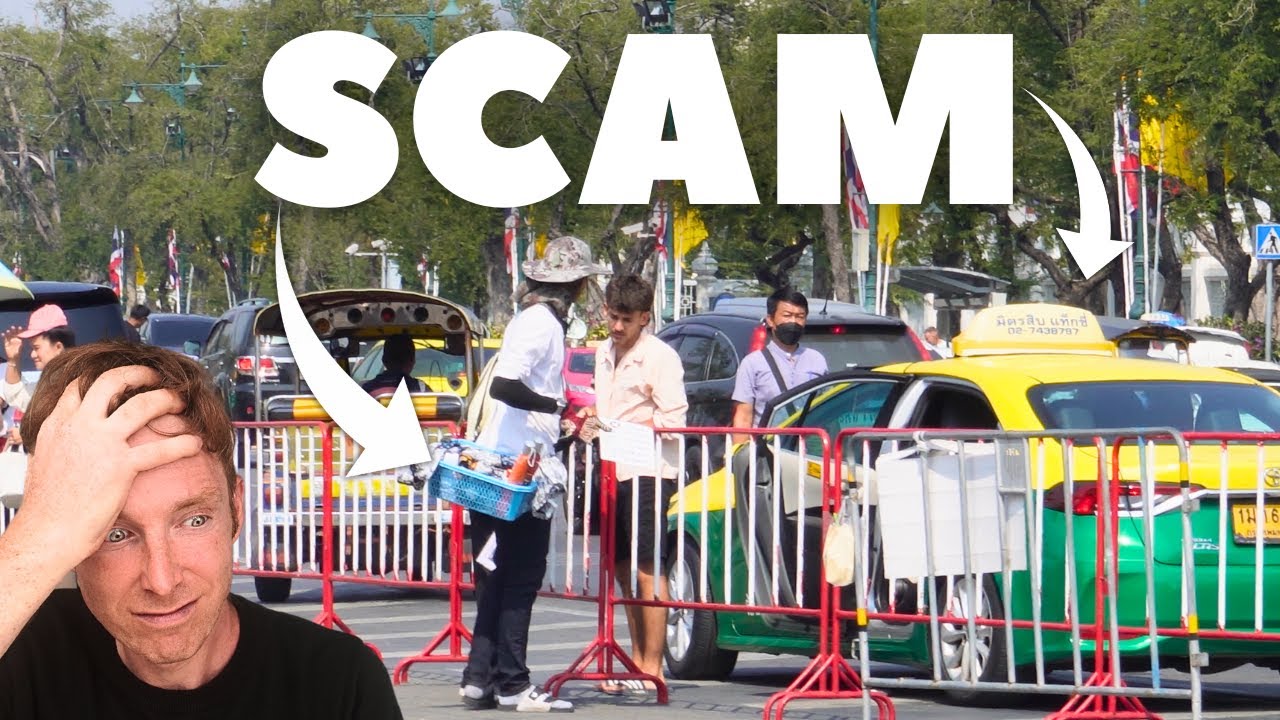
How it works: near the Grand Palace or another big sight, a helpful man tells you it’s closed for a holiday or ceremony and offers a tuk-tuk tour instead. The tour ends at a gem shop or tailor.
What to do: walk to the official entrance and see for yourself. Closures are rare and are posted on official sites.
Free gifts
How it works: a bracelet tied on your wrist, a handful of birdseed, a photo with an animal. Then the bill.
What to do: keep your hands to yourself and decline. Nothing is free in a tourist area.
Touts with a discount
How it works: you’re reading a price board outside a massage shop when someone offers you a better deal, walks you in, takes your money and disappears. He never worked there.
What to do: never follow a tout. Pay the business directly, at the counter.
Pickpockets and phone theft
How it works: phones left on tables and in back pockets go first, especially iPhones. After a theft, you’ll get texts that look like Apple or Google with a link to “find” your phone. It’s a phishing site to unlock it. Some thieves message you offering the phone back for a payment.
What to do: keep valuables in front-facing, zipped pockets. If your phone is taken, mark it lost from another device, ignore every text with a link, and never pay for its return. Cancel cards straight away if your wallet goes.
Professional beggars and stranded travellers
How it works: organised begging groups work the busiest stretches of Sukhumvit, and some foreigners ask newcomers for money for a flight home, or befriend them first.
What to do: if you want to help, give to an established charity. A long-term resident who asks a new arrival for money, or pitches an investment, isn’t a friend.
Shopping and money
Counterfeit-currency exchanges
How it works: near exchange booths in Lower Sukhumvit, someone says they need to change money before a flight and offers you a rate well above the booth’s. The notes are fake.
What to do: only exchange at licensed booths and banks.
ATM and card traps
How it works: standalone ATMs in tourist areas are the likeliest to carry skimmers. Many ATMs and card machines offer to charge you in your home currency, at a poor rate.
What to do: use ATMs inside or beside bank branches and malls, and cover the keypad. Always choose to be charged in Thai baht. Thai banks charge foreign cards a fixed fee of about 220 to 250 baht a withdrawal, sometimes more, so take out larger sums less often.
Fakes, swapped parts and “original” art
How it works: counterfeit clothing is sold openly. The bigger risks are electronics and art. Some stalls sell used phones and laptops with cheaper components swapped in, and some repair shops swap good parts out. Mass-produced paintings are sold as the artist’s original.
What to do: buy electronics from brand stores or large chains, and use large repair shops with good reviews. Treat “authentic” art claims from street sellers with suspicion. Remember that Thai shops generally don’t accept returns.
Gems and suits
How it works: a “government sale” or “export price” on gems that are glass or worth a fraction of the price. Tailor touts take you to shops that cut the suit from cheaper cloth than you chose.
What to do: don’t buy gems as an investment, anywhere. Choose a tailor from reviews, not from a tout, and check the cloth at the fitting.
Menus without prices
How it works: in tourist areas, a meal or drink ordered without seeing a price is priced afterwards. Bars sometimes add drinks to the running tab.
What to do: ask for the menu before you order, and check the bill line by line. In bars, pay for each round as it comes.
Tours, hotels and holiday rentals
The tour that costs extra
How it works: a cheap island or safari tour leaves out an entry fee, or the transfer “back” doesn’t come. On some long van trips, passengers are led into a room and asked for their hotel name, which turns out to be a pitch for more tours.
What to do: ask exactly what’s included, in writing. Book through operators with many recent reviews; Klook and Viator let you compare. In the van-stop pitch, give your hotel name, say no thanks and get back in the van.
The hotel that doesn’t match the photos
How it works: wide-angle shots of a room renovated years ago. A variant on Airbnb is the bait and switch: the large flat you booked is “unavailable”, and you’re given keys to a smaller one.
What to do: check Google reviews alongside booking-site reviews; they tend to be more candid. Report a switch to the platform at once and ask for a refund rather than accepting the swap.
Renting and moving
Fake rental listings
How it works: a condo listed on Facebook Marketplace or a rental site at a good price, with an owner or agent who asks for a deposit, the first month or the whole rent to “hold” it before you arrive. The listing then vanishes, or you’re given a different, worse unit.
What to do: never send money for a home you haven’t seen. Arrive, stay somewhere short-term for a week, and view in person. Rentals are easy to find once you’re here. Bangkok rents from real tours shows what fair rents look like.
Marketplace sellers who are “abroad”
How it works: a seller in a Thailand Facebook group claims to be out of the country and asks for a transfer to secure an item. One payment becomes several.
What to do: pay only when you can see the item, preferably in person.
Fake visa and relocation agencies
How it works: once you search for visa help, advertising follows you, and some advertisers supply fraudulent visas or documents. Using a fake visa is your problem, not the agent’s.
What to do: check any agency’s reviews on Google and Reddit, and check what they promise against the rules on the immigration site. Be wary of any agent who guarantees an outcome or asks you to skip official steps.
Fake title deeds
How it works: forged land or condo titles, or the same title sold to several buyers.
What to do: run a search on the title at the Land Office yourself before any money changes hands, check the seller’s ID matches the name on the deed, and pay only on transfer day at the Land Office, by cashier’s cheque to the owner named on the title.
Online and by phone
Calls and texts from “the police”, “customs” or “your bank”
How it works: soon after you register a Thai SIM, calls and messages begin: a parcel held at customs, a fraud investigation in your name, a bank problem. Some use AI-generated voices or video. Many come from scam compounds in neighbouring countries.
What to do: don’t answer unknown numbers, don’t open attachments, and never pay or give personal details on a call you didn’t make. Hang up and call the organisation on its official number. Report the number to 1441.
Romance and investment scams
How it works: organised teams build a relationship on dating apps or social media over weeks, then introduce an investment platform, a business idea or an emergency medical bill.
What to do: never send money, or crypto, to someone you haven’t met in person, however long you’ve been talking.
Job offers that are too good
How it works: well-paid jobs in Thailand or a neighbouring country, with little experience needed. At best, the “employer” asks for application or visa fees. At worst, the job is a recruitment route into scam compounds across the border, where workers are held against their will.
What to do: never pay to apply for a job, verify the employer independently, and treat any offer involving travel to a border area with great caution. Tell someone at home where you’re going.
If you’re caught out
Stay calm. Scammers usually prefer a quick settlement to a scene, and a raised voice in Thailand tends to make things worse, not better. If it’s a small amount, pay what’s fair, leave, and count it as a lesson. If it’s serious, or you feel threatened, call 1155. Tourist police officers speak English and work with foreign volunteers who have seen every one of these before.
Rules this guide relies on
Stable TDAC: the digital arrival card changed 1 May 2025
Thailand, every Thursday.
One email a week. Free, and you can leave in one click.
- What's on in Bangkok this weekend
- Entry and visa changes, in plain English
- One guide worth reading, kept up to date
Related guides
What's changed
| Date | Change |
|---|---|
| 25 Oct 2026 | First published |
Guidance, not legal, tax or immigration advice. Rules in Thailand can change with little notice; confirm with the official source before you travel.