
Videos · Guides · 23 Oct 2026 · 28 min
Your first hour in Bangkok: Suvarnabhumi arrival, step by step
Suvarnabhumi in the order you meet it: entry rules, the TDAC, e-gates or a booth, cash, a SIM, and the cheapest and easiest ways into the city.
Video: First Hour in Bangkok: New Rules & Complete Arrival Guide
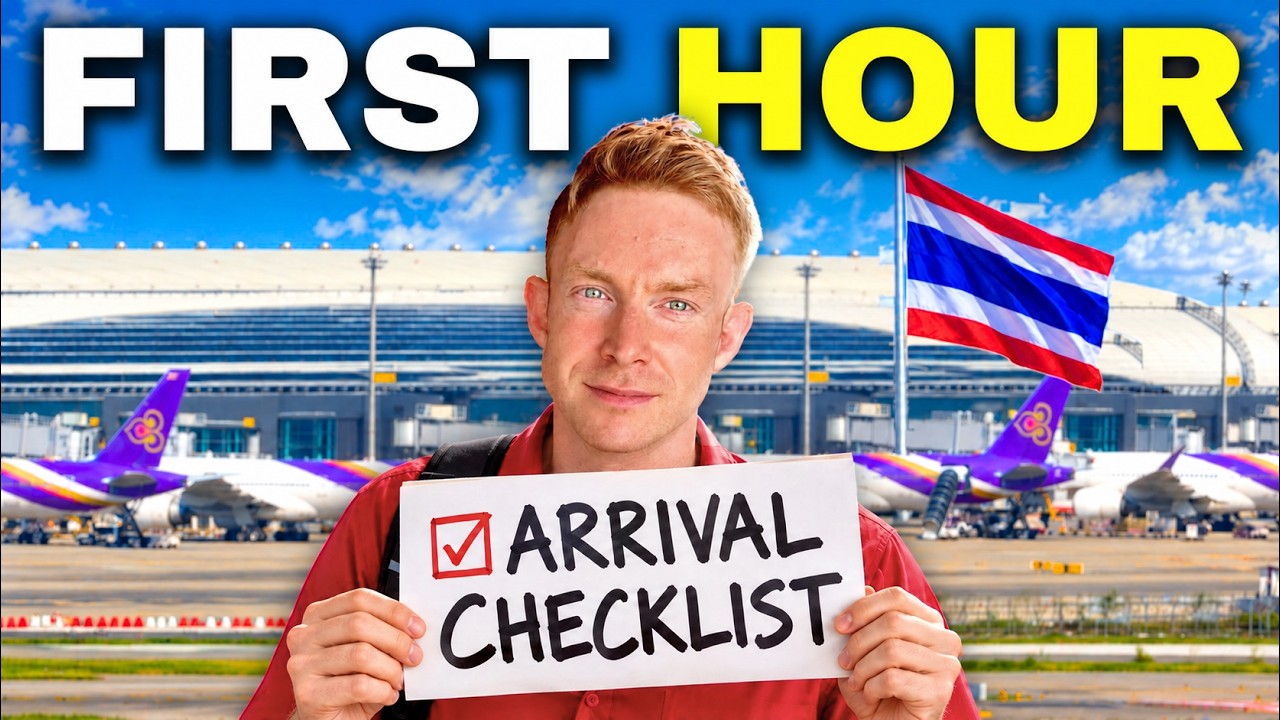
Filmed 23 Oct 2026. Rules and prices in Thailand change often: check entry rules right now and the daily news before you rely on anything here.
The short version
- Check your ticket says BKK (Suvarnabhumi) or DMK (Don Mueang): they're far apart.
- Fill in the free TDAC arrival card within the three days before you land, and only on the official site.
- E-gates are for visa-exempt arrivals only. If you hold any visa, use a staffed booth, or you can be logged as visa-exempt instead.
- Skip the arrival-hall exchange booths: the best rates are in the basement by the Airport Rail Link.
- Thai ATMs give you the cash first and the card second. Wait for your card.
- The Airport Rail Link is the fastest way in (under 30 minutes); taxis add a 50-baht airport surcharge.
Fill in your TDAC before you fly, change money in the basement rather than the arrivals hall, and take the Airport Rail Link into town unless you’re carrying a lot of luggage or landing close to midnight. Do those three things and your first hour at Suvarnabhumi costs less and takes less time than most people’s.
Since filming: on 22 October 2026 the Finance Minister put the proposed 1,000-baht departure tax on hold, with no new date, so there is nothing extra to pay when you fly out. The free shuttle to Don Mueang is for connecting passengers only and leaves from Floor 2, Gate 3; the details below are current as of October 2026.
Who it’s for: first-timers and anyone who hasn’t landed at Suvarnabhumi since the September 2026 rule changes. Who can skip it: residents on long-stay visas who already know the airport; the e-gate and entry sections still apply to you.
The steps run in the order you’ll meet them: before you fly, immigration, customs, cash, a SIM, then the ride to your hotel. For the detail behind each step, see which visa fits your stay, the TDAC, field by field and getting around Bangkok.
Before you fly
Check which airport. Bangkok has two. Suvarnabhumi (BKK) handles most international flights; Don Mueang (DMK) is mainly low-cost regional and domestic. They’re far apart, so check the code on your ticket, especially if you’re connecting.
Check how you’re entering. Passports from 60 countries and territories, including most Western ones, enter visa-free for 30 days. Some countries have separate bilateral deals, and everyone else applies in advance on the official e-Visa portal.
New since 15 September 2026: The 30-day visa exemption is now for tourism only; coming to work or do business needs the right visa. If you cross into Thailand by land, you can use the visa exemption no more than twice per calendar year (Malaysian, Bruneian, Indonesian and Singaporean passports are exempt from that cap). And visa on arrival now covers just three countries: Azerbaijan, Belarus and Serbia. See the entry rules board for the current status of each.
Want longer than 30 days?
- Extend once for up to 30 more days at an immigration office, for 1,900 baht. Approval is at the officer’s discretion.
- Or apply for a tourist visa before you travel: 60 days on arrival, plus the same 30-day extension, for up to 90 days.
The rules that catch people out:
- Your passport needs at least six months’ validity and should be undamaged (no water damage, no torn pages).
- Have an onward or return flight within your permitted stay, and proof of where you’re staying for the first few nights.
- Carry proof of 20,000 baht per person (40,000 per family) in any currency, cash or cards; official figures for visa-free arrivals range from 10,000 to 20,000, and enforcement varies. Being asked is rare on a first or yearly visit, more likely if you’ve had repeated or long stays.
The TDAC arrival card
Every foreign arrival must complete the Thailand Digital Arrival Card within the three days before you land. Without it you can’t clear immigration.
- It takes about five minutes on the official site.
- Double-check your name and passport number before you submit, then save the QR code on your phone.
- It’s free. Sites that charge a fee are agencies or scams, and some harvest your data.
- Forgot, or made a big mistake? There are kiosks before immigration, but expect queues.
E-gates or a staffed booth?
Suvarnabhumi’s arrival e-gates take passports from 33 countries and territories on visa-free entry, including the UK, Canada, Australia and most of the EU. US passport holders use the staffed booths.
Even if your passport qualifies, two conditions apply:
- E-gates are only for visa-exempt entry. The gate asks you to confirm you’re entering on the 30-day exemption, and accepting records you as visa-exempt, not under the visa you hold, which can cause problems later. If you have a tourist visa, DTV, retirement, spouse, LTR or Non-B visa, go to a booth.
- Your passport needs a Thai stamp from a previous trip. First-timers and new passports go through a booth once, then can use the gates next time.
You’ll scan fingerprints and have a photo taken. There’s no passport stamp: you get a receipt instead, and you’ll need it if you extend your stay later.
At a staffed booth it’s much the same, with a little more scrutiny. Most people are simply waved through. If the officer asks about your trip, your onward flight or your hotel, answer calmly and directly.
Good to know: a visa never guarantees entry. Immigration treats long, repeated stays as a sign of living here: as a rough guide, approaching 150 days in a rolling year on exemptions or tourist visas can bring questions or refusal. A normal holiday won’t come close.
Tip: if you’re older or have a disability, request assistance when you book your flight. You’ll get wheelchair support and priority through immigration.
Customs
- Duty-free: 200 cigarettes (or 250 g of tobacco) and 1 litre of alcohol per person. Over that, use the red channel and declare it. Fines can reach four times the value.
- Vapes and e-cigarettes are banned. Leave them at home.
- Medication: keep it in the original labelled packaging, bring a doctor’s letter or prescription, and stick to a 30-day supply. Controlled drugs, especially opioid painkillers, need a Thai FDA permit: apply online at least two weeks before you travel.
- Cash: declare Thai baht over 450,000. Declare foreign currency too once it’s over US$15,000 or the equivalent, in all currencies combined.
Finding your way around the airport
| Level | What’s there |
|---|---|
| 4 | Departures (good views of the planes) |
| 3 | Restaurants and shops |
| 2 · Arrivals | SIM counters, hotel desks, tourist police, luggage storage, the first (pricier) exchange booths |
| 1 | Official taxi queue, Grab pickup, buses, Magic Food Point food court |
| Basement | Airport Rail Link, best-rate exchange booths, luggage storage, sleep pods |
Getting cash
Don’t exchange at home. Rates in Thailand are almost always better.
ATMs are everywhere and take most foreign cards, but fees add up:
- Thai banks charge foreign cards about 250 baht a withdrawal, and some charge more (we were charged 350 on a Mastercard at the airport in October 2026). Take out larger amounts less often.
- Most machines cap a withdrawal at 30,000 baht; some at 25,000 or less.
- Decline “charge me in my home currency”. That’s dynamic currency conversion, and at Kasikorn it came with a 5.5% spread when we checked (October 2026). Let your own bank convert.
- Cash comes out first, then your card. It’s the reverse of most Western machines, and tired travellers walk away without their card. Carry a backup.
- Withdraw an odd amount (3,900 instead of 4,000) to get smaller notes for taxis and street food.
A travel debit card that refunds ATM fees is the best option: Charles Schwab is popular with Americans, Wealthsimple with Canadians.
For the best exchange rates, go down to the basement by the Airport Rail Link entrance. Tucked to the left are the dedicated booths (SuperRich and Happy Rich). Check the boards, bring clean, crisp, large notes, have your passport ready, and count your money at the counter. They’re open 6am to midnight; the bank booths upstairs open 24 hours.
Getting online
North Americans: make sure your phone is unlocked before you leave, or you won’t be able to use a Thai SIM or an eSIM.
You have three choices:
- A tourist SIM at the airport. AIS and True counters are right in the arrival hall and all charge the same: when we checked in October 2026, from about 400 baht for five days to around 1,200 baht for 30. Staff install it for you. Easy, but you pay for the convenience and may queue.
- An eSIM, set up before you fly (Ad · Sponsor: Yesim, code CAL15 for a discount). No counter, and you’re online when you land. Not for you if your phone is carrier-locked. Who it suits.
- A local prepaid SIM is cheapest for longer stays: any 7-Eleven in the city (not the one in the airport) or an AIS or True shop in a mall. Shops only sell monthly plans. Bring your passport to register it.
Staying over a month? Use an eSIM to get online on arrival, then switch to a local prepaid SIM once you’re settled.
Apps to install: Grab, Bolt and InDrive (rides; Grab and Bolt take cards), LINE (Thailand’s main messaging app), Grab Food and LINE MAN (delivery), Klook (tours and tickets), RainViewer (for sudden downpours), and Google Maps and Translate with offline packs downloaded.
Getting into the city
Airport Rail Link: cheapest and fastest
From the basement, 15 to 45 baht. Change to the MRT at Makkasan or the BTS at Phaya Thai, and you’re in town in under half an hour. Buy a token at the machine or counter, or tap an international credit card at the gate. Guards clear the train before boarding: wait for the whistle to stop.
The catch: it doesn’t run through the night. If you land late, check the last train time at the station before you queue for a ticket, or head straight up to the taxis.
Official taxis
On level 1, take a queue ticket from the kiosk. Keep the ticket: it has the driver’s details and how to complain.
- Pay the meter, plus a 50-baht airport surcharge. Large bags can carry a small extra charge.
- Expressway tolls are extra, paid in cash, usually 25 to 100 baht, and normally worth it.
- Make sure the meter is on. Expect about 300 to 500 baht to central Bangkok, including the surcharge and tolls. At rush hour the drive can take 60 to 90 minutes.
Grab and Bolt
Prices are similar to taxis, but the ride is tracked and you can pay by card. Grab has an organised pickup zone on level 1, past the taxi queue. Bolt is often cheaper but has no fixed pickup point: message your driver and look for the plate at the kerb.
Buses and onward travel
The S1 bus to the Khao San Road area costs 60 baht and runs about once an hour, 6am to 8pm, from level 1 near Gate 7. Air-conditioned coaches to Pattaya, Hua Hin and the islands leave from the same level, from about 150 baht.
Connecting to a flight from Don Mueang? A free shuttle leaves from Floor 2, Gate 3, every 30 to 60 minutes from 5am to midnight. It’s only for passengers with a connecting flight, so show your onward boarding pass with your passport. Allow one to two hours; if you’re tight on time, take a car.
Before you leave the airport
- Travel insurance isn’t required to enter, but accidents and illness are common and private hospital bills add up fast. See what we recommend and who it suits, and what treatment costs.
- Eat cheaply at Magic Food Point on level 1, next to the taxi exit. Buy a prepaid card at the counter (vendors don’t take cash) and get the balance and deposit back afterwards.
- Luggage storage is in the basement by the rail link, with automated lockers from about 30 baht an hour when we checked in October 2026. Sleep pods nearby were about 250 baht an hour.
- The whole airport is no-smoking, inside and out. Use the designated smoking rooms or risk a fine.
Scams to avoid
They’re still fairly rare at the airport, but common in tourist areas.
- The friendly currency chat. A friendly person or family asks about your trip, then about your currency, and uses sleight of hand to pocket notes or swap in fakes.
- The stranded traveller. Usually a Western backpacker with a lost-wallet story. Walk away.
The rest are in scams in Thailand.
Save these numbers: Tourist police 1155 (desk on the arrivals level), police 191, ambulance 1669.
Chapters
- 0:00Your first hour starts here
- 1:26Entry rules and visas
- 3:18The TDAC arrival card
- 4:18E-gates or staffed booth?
- 7:58Customs
- 10:23Getting cash: ATMs
- 13:30The best exchange rates
- 15:21SIM cards and eSIMs
- 19:22Airport Rail Link
- 20:18Official taxis
- 22:10Grab and Bolt
- 23:21Car rental and no smoking
- 23:31Buses
- 24:48Travel insurance
- 25:18Cheap eats: Magic Food Point
- 25:43Luggage storage and sleep pods
- 26:43Scams to avoid
Watch next
 35 minCondo & house tours · $2,500/month · Written guideA 145 m² Soi 8 corner condo for 85,000 baht, down from 110,00028 Oct 2026
 33 minCondo & house tours · $750/month · Written guideA $750 condo in Phrom Phong, and the two-year lease that got it19 Oct 2026
 46 minInterviews · Written guideStuart Jay Raj on why Thailand bends for foreigners, then snaps back17 Sept 2026
Thailand, every Thursday.
One email a week. Free, and you can leave in one click.
- What's on in Bangkok this weekend
- Entry and visa changes, in plain English
- One guide worth reading, kept up to date