
Videos · Guides · 14 Jan 2025 · 11 min
ATMs, cards and exchange booths: how to get baht in Thailand
Take most of your cash from ATMs in a few big withdrawals, decline conversion to your home currency, and change notes only at the big booths.
Video: Money in THAILAND - 15 Worst ATM and Exchange Mistakes
Rules may have changed since this was filmed. Current rules: Entry rules right now
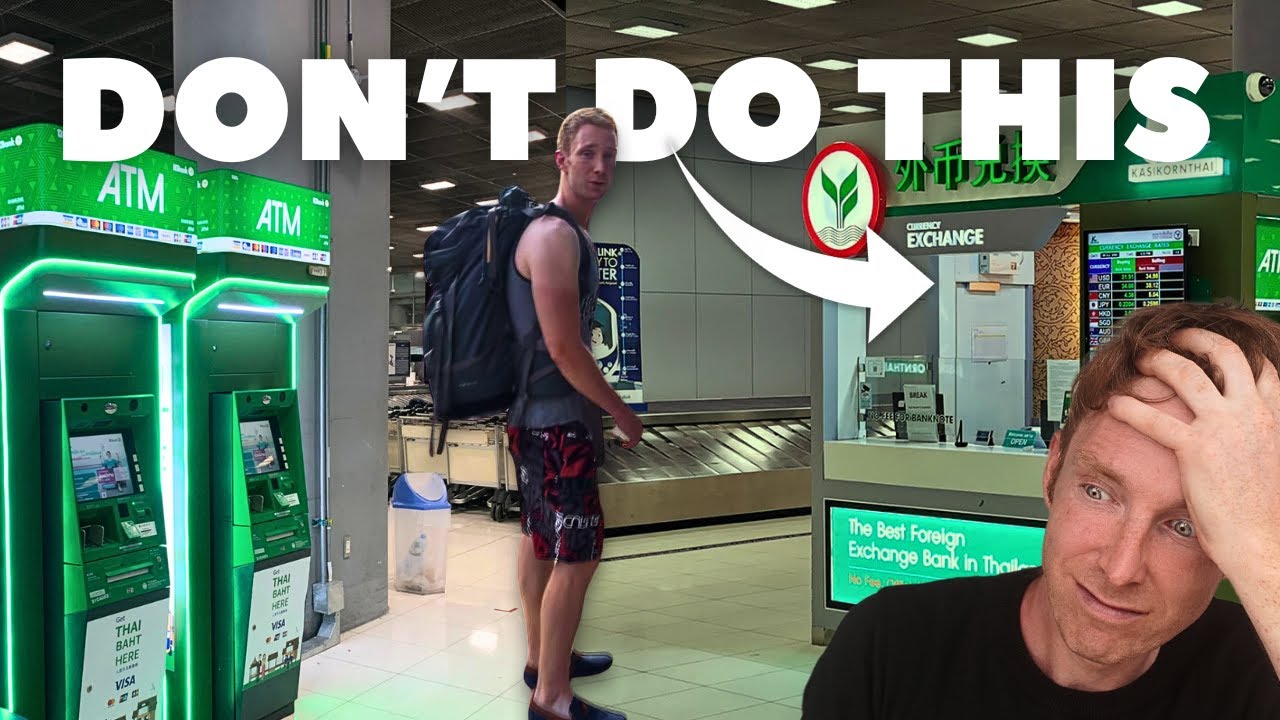
The short version
- Thai ATMs charge foreign cards a fee on every withdrawal, about 250 baht (read the fee on the screen), so take out larger sums less often.
- Always choose to be charged in baht. Accepting your home currency lets the machine set the exchange rate.
- Most machines pay out the cash first and give the card back afterwards. Wait for the card.
- Carry two cards from separate accounts, and keep your bank's overseas phone number somewhere you can reach without the card.
- Change cash at the large dedicated booths with your passport and clean notes, not at a hotel desk or home before you fly.
- Declare Thai baht over 450,000, or foreign currency over US$15,000 or the equivalent.
Use a Thai ATM for most of your cash, withdraw the machine’s maximum each time, and say no when the machine offers to charge you in your home currency. Change physical notes only at the big dedicated booths, never at a hotel desk and never before you fly.
Who it’s for: anyone arriving with a foreign debit or credit card who needs cash for markets, taxis and street food. Who can skip it: residents with a Thai bank account and a Thai debit card, who pay no foreign-card fees.
ATMs: the default, and the three ways they cost you
ATMs are everywhere, take Visa, Mastercard, UnionPay and JCB, and pay out in baht at a network exchange rate that is usually close to the wholesale rate. Three things eat into that.
The machine’s fee. Thai banks charge foreign cards a flat fee per withdrawal, whatever the amount. Expect about 250 baht, and read the fee on the screen before you confirm. On 5,000 baht that is 5%; on 30,000 it is under 1%. Take out the most you can, less often.
Your home bank’s fee. Many banks add their own foreign ATM fee, or a percentage on top of the exchange, and some refund the Thai machine’s charge. Ask before you fly. The cheapest fix is a travel debit card that waives them.
The limit. Thai machines cap each withdrawal; limits vary by bank, commonly 20,000 to 30,000 baht, so check the screen. You pay the same flat fee on 5,000 as on 30,000, so the highest cap is the cheapest cash. Your home bank may set a lower daily limit than the machine, so check yours.
The catch: if you take a second card to a machine with a lower cap, you pay a second fee for the rest.
Cash first, card second
Many Thai machines pay out the cash and give the card back afterwards, the reverse of the order at home. Walking off with the notes and no card is an easy mistake to make, so wait until the card is out.
If a machine at a bank branch keeps it, go inside when the branch opens; a standalone machine means calling the number printed on it, or your own bank.
Cards that cut the fees
Wise and Revolut give a monthly allowance of free ATM withdrawals, then charge a percentage or flat fee; the allowance depends on your country and plan, so check your own app. Neither refunds the Thai machine’s fee. A travel debit card from your own bank may refund both.
A credit card is the better tool for paying, not for cash. Most hotels, restaurants, malls and delivery and ride apps take cards, and Bangkok’s MRT gates take contactless bank cards (see getting around Bangkok). The catch is your issuer’s foreign transaction fee, so use a card that waives it.
A cash advance on a credit card is usually the most expensive way to get baht, with its own fee and interest from day one, so avoid it. Ask whether an app or merchant adds a card surcharge before you pay.
Decline the conversion offer
The machine may ask whether to charge you in baht or in your home currency. Choose baht. Accepting your own currency is dynamic currency conversion: the machine’s operator sets the rate and adds a markup, instead of your bank applying the network rate.
If both figures are shown, compare them. The baht option is almost always cheaper.
The same trap appears at shop and hotel card terminals.
Carry two cards, and protect them
Take two cards from separate accounts, kept apart. If one is swallowed, lost, skimmed or frozen by your bank’s fraud system, you still have money.
- Tell your bank you’re travelling, and save its overseas phone number on your phone, on paper as well, because the card may be gone. A free internet-calling app works if your own SIM can’t dial abroad.
- Use machines inside bank branches, malls and shops rather than standalone ones on a quiet street, and cover the keypad when you type your PIN.
- Keep one account as your spending account and top it up from savings, so a compromised card can’t reach everything. Check statements often.
For other ways visitors lose money, see scams in Thailand.
Changing cash
Bring notes for booths and markets; take most of your cash from ATMs. Thai booths pay better rates than any exchange at home, so don’t buy baht before you fly.
| Option | Best for | Cost | The catch |
|---|---|---|---|
| ATM | Most of your cash | About 250 baht a withdrawal plus your bank’s fee | Limits vary by bank, commonly 20,000 to 30,000 baht |
| Dedicated exchange chain | Changing notes | No fee; you pay in the rate | Bring your passport and clean notes |
| Bank booth or hotel desk | Convenience only | Usually the worst rate | You pay for the location |
| Credit card | Paying in shops and apps | Your issuer’s foreign fee | Not for cash |
Where to change. The big dedicated chains, SuperRich among them, usually beat banks and hotels, with branches across Bangkok and at Suvarnabhumi.
For a large sum, go to a main branch rather than a small booth. The first-hour guide shows where the airport booths are.
How to change.
- Bring your passport; booths often ask to see it.
- Bring clean, undamaged notes. Torn, marked or very old notes are often refused or discounted.
- Bring large denominations. For US dollars, a 100 normally gets a better rate than a 20.
- Count the money at the counter before you walk away.
How much cash you can carry
Foreign cash has no cap going into Thailand, but customs wants to know about large sums. Declare Thai baht over 450,000, or foreign currency over US$15,000 or the equivalent, when you arrive or leave.
Taking baht out of the country is capped; check the Bank of Thailand’s exchange-control page.
Your home country has its own rule for the trip back.
Withdraw the machine’s maximum and carry only what you need. Before you fly, check the entry rules board for the full arrival checklist.
Chapters
Watch next
 28 minGuides · Written guideYour first hour in Bangkok: Suvarnabhumi arrival, step by step23 Oct 2026
 33 minCondo & house tours · $750/month · Written guideA $750 condo in Phrom Phong, and the two-year lease that got it19 Oct 2026
 41 minCondo & house tours · $2,560/month · Written guideA $2,560 house in Bang Na: what 85,000 baht buys a family of six14 Sept 2026
Thailand, every Thursday.
One email a week. Free, and you can leave in one click.
- What's on in Bangkok this weekend
- Entry and visa changes, in plain English
- One guide worth reading, kept up to date