
Videos · Condo & house tours · 22 Nov 2026 · 1 h 11 min
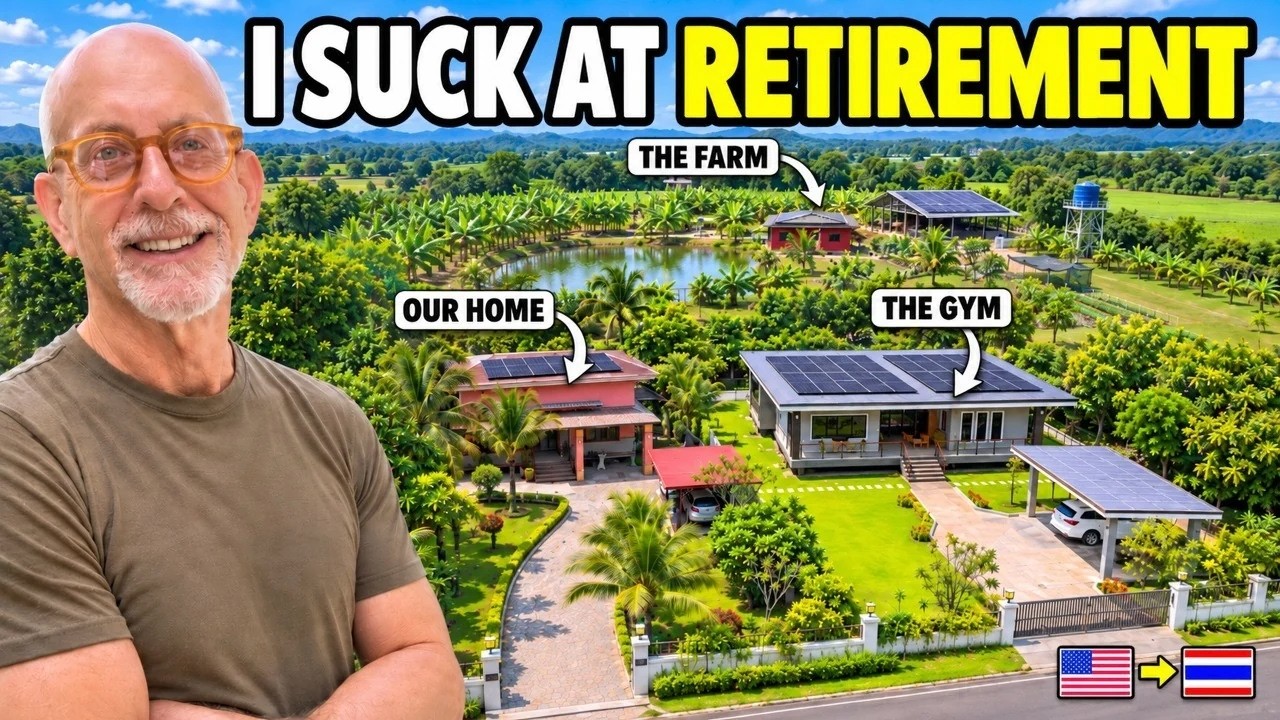
Two solar houses and a farm in Phetchabun, the first built on FaceTime
What it cost (about 10 million baht), why his Thai wife holds both title deeds, and what the first house taught him about floods, floors and builders.
Video: He Left California for Rural Thailand and Built Two Off-Grid Homes plus a Farm
Filmed 22 Nov 2026. Rules and prices in Thailand change often: check entry rules right now and the daily news before you rely on anything here.
The short version
- Two single-storey houses in his wife's village: about 1,400 sq ft (130 sq m) built in 2020, and about 2,200 sq ft (204 sq m) built in eight months, both on solar and well water.
- Mark puts the cost at about 10 million baht (roughly US$300,000) for land, construction, solar, well and wall.
- Foreigners cannot own land in Thailand. His wife holds both title deeds, and Mark holds no registered right of his own.
- His building advice: get proper plans, vet the builder on past work and with the community, and listen to your Thai family.
- The trade-offs: a three-and-a-half-hour drive to Bangkok, summer heat he puts at 105 to 107°F, strong winds, and a quiet province with fewer things to do.
The first post went into the ground in January 2020. Then Covid closed the border, and Mark spent the rest of the build watching his house go up on FaceTime from California.
By the time the builder handed over the keys in October 2020, Mark had a three-bedroom house standing in his wife’s village in Phetchabun province, about three and a half hours’ drive north of Bangkok. Mark settled in the village for good, and six years on he has built a second, bigger house in the same area, and the family farm down the road has more bananas than anyone can eat.
Why a village house is a different project
A village build runs on different rules from a Bangkok rental. The land belongs to families, the builder lives down the road, and the foreign husband holds no title. Mark has now done it twice, and the second house shows what the first one taught him.
The numbers
- First house (2020): about 1,400 square feet (130 sq m), single storey, three bedrooms, teak floors and ceilings, a raised floor and a combined sitting room and kitchen.
- Second house (2026): about 2,200 square feet (204 sq m), one bedroom plus a sofa-bed living room, a large gym, two bathrooms and a separate utility building for the solar gear. Land bought in October 2025, first post that January, finished eight months later.
- The cost: about 10 million baht, roughly US$300,000, for land, construction, solar, well and perimeter wall, by his account.
- Power: the first house has solar, with city power and water as the backup. The second runs entirely on solar, with an inverter and batteries, and also charges his hybrid car.
- Water: wells on both properties, plus city water. At the second house, one tank holds city water and the other well water.
- Running costs: he says the power bill is “incredibly cheap” and the sprinklers for the lawn run on well water.
“I couldn’t touch that in Los Angeles,” he says of the money. He also calls it “a lot of money for Phetchabun.”
The gym that became a house
The second house was never meant to be a house. His wife looked at the gym equipment rusting on the first house’s back porch and suggested a small gym.
“I go, that’s great, but if we put in a gym, we need a bathroom. Well, if we’re going to do a bathroom, we might as well have a guest room.”
It spiralled. The gym is now air-conditioned, with a treadmill, cable machine, rack of weights and a speaker for his Springsteen. Outside the living room is a mural in the style of Nan’s temple paintings, done by local artists who spent a week on site; inside are baskets woven near Phichit, his wife’s mother’s home area. The plans changed twice during the build: his wife had the living room pushed out because it felt too small, and the bathroom count went from one to two.
He says it came out with a California-style ranch feel, quite different from the first house’s Thai cabin look. Both are single storey. In a village with no two- or three-storey homes, he says, you copy the neighbours: “when in Rome.”
Who owns the land
Mark did not go looking for land. In a village, he says, plots belong to families and carry value beyond price, so an outsider’s money does not buy a place in the queue. “You can’t go around saying, ‘Oh, I’m an American. I’ll pay a premium for it.’ You have to wait until somebody basically offers you.”
The plot for the second house was offered to them. It had been part of a larger deed that the sellers split, and his wife holds both title deeds. He did not take a lease, usufruct or any registered right of his own, though he says he could have.
The current rule: under the Land Code, foreigners cannot own land in Thailand. The usual ways to build on land you do not own are a registered lease (a lease over three years has to be registered at the land office), a usufruct, or a right of superficies, which lets you own what you build on someone else’s land. When a Thai spouse buys land, the Land Department requires a written declaration that the purchase money is the Thai spouse’s separate property.
He has been with his wife almost 20 years.
A building permit is also needed for a new house; ask the local administration.
Power, water and keeping the floods out
“What I didn’t want to leave behind is something that costs a lot to power and cool and water,” he says. Solar went onto every property, with wells beside it.
At the first house the panels were fitted by a Swiss-run company, and he says the rules were tougher then. For the second, a local installer did it more cheaply. He says the government has since made solar easier and added incentives.
The second house is built around lessons from the first:
- Drainage. Downspouts on every flat surface and a drain around the perimeter that runs under the road to the community drain. The first house had some flooding and needed fixing.
- A raised floor. It keeps the house cooler, lets air through underneath and means no flood water enters.
- Wide parking and a turning circle, because his wife hated reversing out of the first driveway.
- Louvred shutters on the outdoor kitchen. The wind in Phetchabun can blow rain into the cabinets.
- No air-con in the bathrooms. A ceiling fan and an open window keep them cool.
What he would tell anyone building
His advice for a village build is short.
“Planning is everything. Failing to plan is planning to fail.” Get proper plans, and if needed have an architect or engineer in Bangkok draw them. Then check the builder: look at what he has built, and ask around the community. Good plans and a good builder, he says, get you about 90 percent of the way there.
Then listen to the family. “I’ve learned here that my family almost always has a better way to get stuff done.” When he needed 180 truckloads of dirt to raise the second plot, his wife insisted they ask a village official who sold dirt before using the builder’s supplier. In a small community, she said, they had to show respect.
And look after the crew. “Treat your builders and treat their crew like family.” On Fridays he brought shaved ice or a case of beer.
Some other points from his two builds:
- Build storage you think you do not need. He added it after the fact on the first house, and built it in from the start on the second.
- Skip the shipping container. Furniture chains such as Index Living Mall and IKEA mean you do not need to ship furniture, he says.
- Expect to tweak. Both houses had a short list of fixes: a door, a few tiles, a window.
What the builder didn’t say
His builder would not say certain things to him directly. Mark’s grown son and his wife’s niece carried the messages back and forth.
“I used to say that all the time,” Mark says of the foreigners who ask why Thais will not talk to them directly. His advice is to work out what people actually mean and leave them a way out, so nobody has to say no to your face. The builder was being respectful, he thinks, of their age and social position, which Mark himself does not care about but which mattered to the builder.
He did not expect the culture to take so long. “Don’t think you’re going to come here and in 30 days or 60 days or even six months figure out how it all works.”
The farm
Down the road is the family farm, a long strip that runs from the road back to a tree line. Part is fruit: banana, papaya (30 to 50 fruit on a tree), guava, dragon fruit and a young stand of coconuts that he expects to bear in a year or two. Corn, rice, beans and sugar cane grow on the rest.
There is a pond stocked with fish (“they’ll take the food, but they ain’t becoming food”), a coop of laying hens, and two small air-conditioned cabins, one of them a flat-pack bungalow that arrived on a truck onto a poured pad. The other is a bedroom by the pond. Family members who live on site look after the animals and keep what they can sell, and a guava harvest, he says, made about US$700 at the market.
The eggs are the thing he raves about. The hens eat banana, guava and insects, and the yolks come out bright orange. “I don’t eat any eggs when I’m in Phetchabun except those.”
He is clear about what the farm is for: “Potable water and arable land, I think, is just going to become more and more valuable over time.”
The catch
- It is quiet. Provinces offer fewer things to do than Bangkok or Phuket. “I suck at retirement,” he says, and for a while he spent his weeks in Bangkok and weekends here. The first year of that drive was “terrifying”, with trucks and motorbikes with carts, and he learned to drive defensively and put on a podcast.
- The heat. Mark says the hot season in Phetchabun reaches 105 to 107°F (about 41 to 42°C).
- Dogs and snakes. Roaming soi dogs make cycling harder than the dedicated riverside path he used in Los Angeles. The snakes get picked up by the tail and thrown into the forest.
- Language. He can order food and talk about the weather. He says the tones are the hardest part and that “the English transliteration is crap.”
What to do: Weighing a build or a purchase? Read buying a condo in Thailand and retiring in Thailand first.
What’s next
Mark says they are done building for a while, unless the plot next to the second house comes up. He and his wife are heading to the US for a family visit, and he has places to show the next visitor: the ruins of Si Thep, a Dvaravati-era town that UNESCO listed in 2023, and the mountain resort of Khao Kho.
For now, the plan is a hammock, a book and a gate that closes. “I’m going to go take a nap and read a book,” he says. “I got to calm down a little bit.”
Chapters
- 0:00Coming up: a gym, a farm and a lot of bananas
- 0:54From Los Angeles to his wife's village
- 3:53The garden and the koi pond
- 6:26"I suck at retirement"
- 9:57Inside the first house
- 18:32Outdoor living, snakes and a kitchen for frying
- 24:41Who owns the land
- 25:54The second house, in eight months
- 34:42The gym that started it all
- 36:52Inside the second house
- 49:06His advice on building
- 53:34What the move taught him
- 56:36The family farm
- 1:09:04What's next
Useful next
Some links here earn us a commission. It never changes what we show, the order or how we describe it. How this works
- Home FinderFree matches for condos and houses in Bangkok, Pattaya, Chiang Mai, Phuket and Hua Hin, picked from your budget, area and move date.
- Echo ThaiLearn the Thai you'll actually use, with real voices and tone practice.
- WiseSend money from home to a Thai account at the mid-market rate, with the fee shown up front.
Watch next
 56 minCondo & house tours · $1,300/month · Written guideA 45,000-baht corner two-bed at Life Rama 4, and the amenities he skips20 Nov 2026
 34 minInterviews · Written guideBlack and Thai in Bangkok: Lizzy on beauty, tact and saying no17 Nov 2026
 46 minCondo & house tours · $1,002/month · Written guideA $1,000 Punnawithi duplex the listings said wasn't available15 Nov 2026
Thailand, every Thursday.
One email a week. Free, and you can leave in one click.
- What's on in Bangkok this weekend
- Entry and visa changes, in plain English
- One guide worth reading, kept up to date